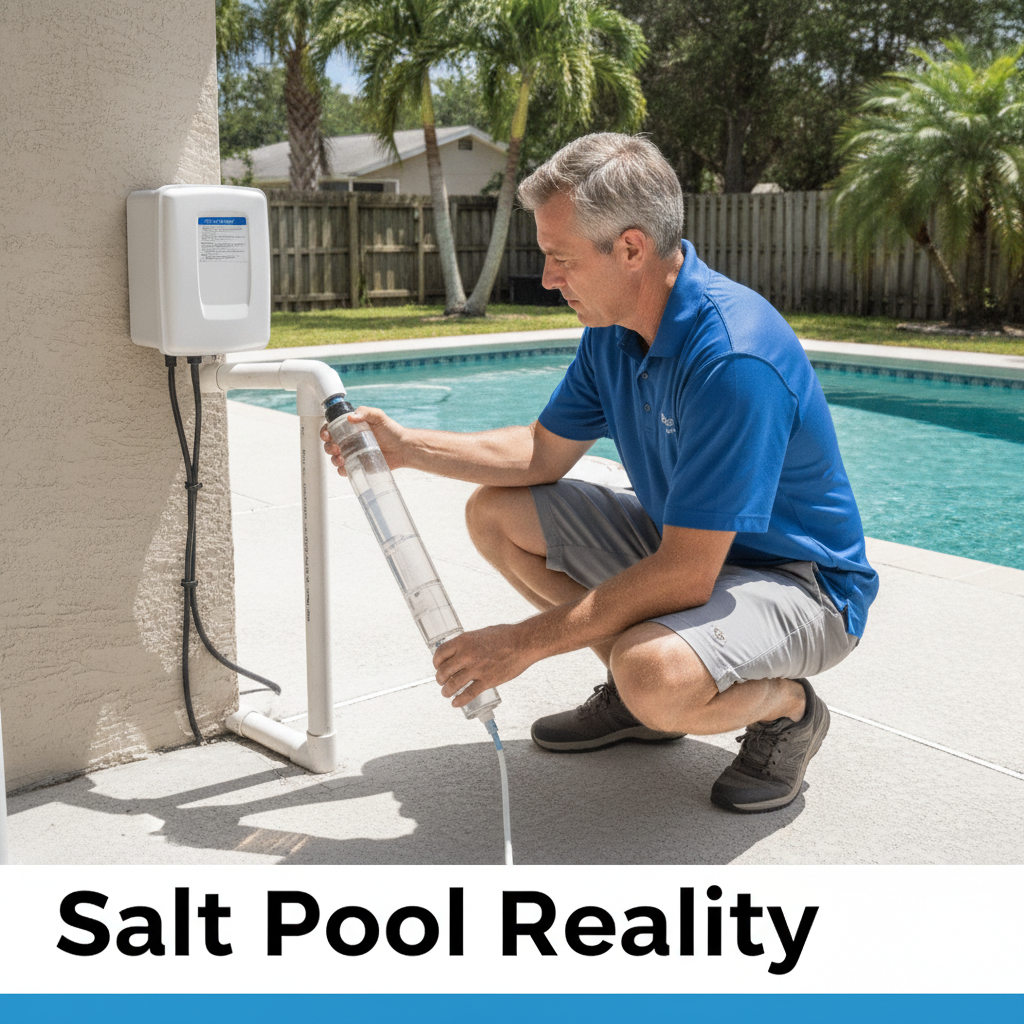
Salt pools are not lower-maintenance pools
They are differently-maintenance pools. That distinction matters when you are building a route and deciding what to charge. Customers hear "saltwater pool" and think set-it-and-forget-it. You know better. The sanitation method changed. The workload did not disappear, it just moved.
Cell inspection is the job nobody accounts for
A salt chlorine generator cell needs to be pulled and inspected every service visit, or at least every other one in scale-heavy water. Calcium builds up on the plates. A cell running at 50 percent efficiency because of scale is not generating enough chlorine, and the customer's pool goes green, and they call you. So you pull the cell, you look at it, you acid-wash it if needed, you reinstall it, you check the flow switch, you confirm the output reading on the controller. On a clean cell in soft water that takes maybe four minutes. On a scaled-up cell in hard water it can take twelve to fifteen minutes before you even start your normal service routine.
On a chlorine pool you spend that same time dosing and moving. On a salt pool you spend it on the generator. Neither is wrong. You just need to know which one you're signing up for before you quote the job.
Stabiliser drift is real and it compounds
Salt pools lose CYA slowly but they do lose it, through splash-out, backwash, and rain dilution. Because the generator is handling day-to-day sanitation, customers and some techs stop thinking about stabiliser. Then one hot July the CYA drops to 30, the cell is working overtime to compensate, the FC is bouncing around, and you are fielding algae calls.
Test CYA on every salt pool every visit, or at minimum every four weeks. Do not assume it is holding because the water looks fine. Build that test into your standard visit and do not skip it because you are running behind. A salt pool with CYA at 20 in direct sun is a problem waiting to be billed back to you in free service calls.
The other stabiliser issue is high CYA. Some customers add stabiliser on top of a salt pool unnecessarily, or it was already high when they converted. Above 80 ppm you are fighting the chlorine's effectiveness. Above 100 you are in a drain-and-refill conversation. Salt pools are not immune to overstabilisation, and they are not immune to the same bad habits that get conventional pools into trouble.
The chemical bill looks lower until it doesn't
This is the pitch customers make to themselves: no more buying chlorine tablets, lower chemical costs. And it is partly true. Your liquid chlorine or tablet spend on a salt pool is lower. A conventional pool on your route might run you $4.80 to $6.00 a week in chlorine depending on volume and bather load. A salt pool might be $1.50 in chemicals on a normal week.
But factor in the cell. A residential salt cell runs roughly $180 to $350 depending on brand and size. It lasts three to five years in reasonable conditions, less in hard water or if it gets neglected. Some customers will want you to supply and install it. Even if they buy it themselves, you are spending time on installation and commissioning. If you are pricing a salt pool identically to a chlorine pool because the chemical cost is lower, you are trading savings on trichlor for time on the cell and nothing in your pocket.
How to price a salt pool relative to a chlorine pool
Start with your base visit price and your time. Say your standard 75,000 litre residential pool is priced at $110 per month. That assumes roughly 17 minutes on site per visit, four visits, $4.80 per visit in chemicals, and about 11 minutes of drive time per stop. Your margin is built around that structure.
Now run the same numbers on a salt pool. Chemical cost drops, say $1.50 per visit. But add two to four minutes per visit for cell inspection and controller checks. Add a pro-rated allowance for your time when the cell needs an acid wash, which you will do two to four times per year. Add a small buffer for the cell replacement conversation that happens every three to four years.
The way most operators handle it on a saltwater pool service route is one of two approaches. First option: price the salt pool at the same monthly rate as the equivalent chlorine pool, keep the chemical savings, and absorb the extra time. This works if your visits are already efficient and the cell time genuinely averages out. Second option: price the salt pool $10 to $20 higher per month, be transparent with the customer that cell maintenance is included in that rate, and track it. This is cleaner if you have multiple salt pools because you always know what you are covering.
Acid washing a cell costs you roughly fifteen minutes and a small amount of muriatic acid. If you are doing that twice a year per pool and not accounting for it anywhere in your pricing, it adds up across a route with ten salt pools. That is five hours of unbilled labour per year just in cell cleaning.
What to document on every salt pool visit
- Cell output percentage from the controller display
- Whether the cell was inspected visually and the condition you found
- CYA reading, every visit or every four weeks at minimum
- Flow switch status
- Any error codes on the controller
This documentation protects you when a cell fails and the customer wants to argue about it. If you have eight months of visit notes showing the cell was reading 40 percent output and you flagged it twice, you are not eating that replacement. If you have nothing on paper, you are having a harder conversation.
Running salt pools efficiently
Group your salt pools geographically the same way you group any stop. The extra cell time is not a reason to scatter them. If you are using route management software, log the cell condition as a custom field on each visit. getLucci lets you track per-pool notes and flag items for follow-up, which is useful when you are managing a mix of salt and chlorine pools across a route and do not want to rely on memory for which cell is due for cleaning.
Salt pools are good business if you price them correctly and build the inspection habit from day one. They are a slow drain on margin if you treat them like a chlorine pool with less chemical spend and nothing else.
If you are building or reorganising your route, getLucci is free for your first 50 pools. Worth looking at if you want a simple way to track visit notes and customer details without a lot of setup.