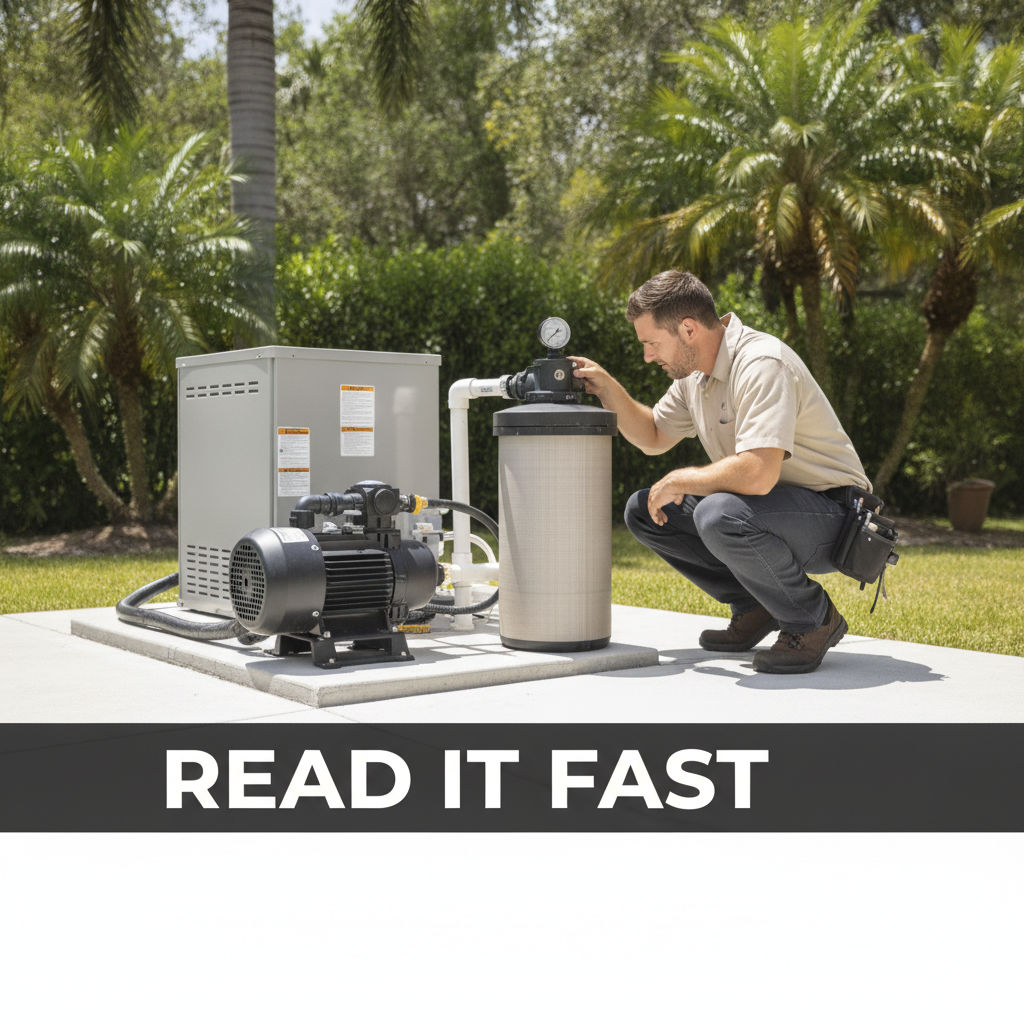
Why Order Matters
A new tech standing in front of an equipment pad sees everything at once and processes nothing. An experienced tech has a route. Same pad, same sixty seconds, but they leave knowing the system is healthy or knowing exactly what is wrong. This post gives you that route in writing so you can hand it to someone and have them actually use it.
This is not a comprehensive pool equipment pad inspection checklist for every edge case. It is the fastest version that catches the most common problems. Save the deep dives for when something flags here.
Start With the Pump
Look before you touch. Is water moving through the strainer basket lid? You want to see full flow, no air bubbles, basket not packed with debris. Air in the pump at startup that does not clear in thirty seconds means a suction-side leak or a bad lid o-ring. Note it.
Listen. A pump that is cavitating sounds like gravel in a dryer. A pump that is about to fail on the bearings has a low hum that has gone slightly rough. You learn to hear the difference after a few months on the same routes. Until then, if it sounds wrong, write it down.
Check the pump lid o-ring visually every single visit. A cracked o-ring costs you two minutes and a dollar fifty to replace on site. The callback when it fails mid-week and the pump runs dry costs you the whole return trip plus the customer's frustration.
Move to the Filter
Read the pressure gauge. You should know, or find out right now, what this filter runs at clean. Write it on a piece of tape on the filter body if you have to. A reading ten PSI above that baseline means it needs a backwash or a clean. A reading below baseline with good flow can mean a cracked internal or a bypass problem, which is less common but worse.
For a DE filter, check the sight glass or the waste line if you backwashed. Cloudiness in the return after a backwash that does not clear up means a torn grid or a bad manifold. For a cartridge filter, you are trusting your pressure gauge more because there is nothing else to look at from the outside. For a sand filter, a pressure gauge that never moves between visits and never needs backwashing is not a win. That sand may be channeled and passing debris straight through.
Check for moisture around the filter tank seam and around the drain plug. A weeping seam on a fiberglass tank is a future blowout. Note the date you first saw it.
Check the Heater If There Is One
Is it on? Should it be? Check the set point matches what the customer expects. A gas heater with an error code on the display gets a photo and a note. Do not reset codes without writing down what the code was. That code is information. Resetting it erases the history the service tech or the manufacturer is going to want later.
Look for soot or heat discoloration on the top or back of the cabinet. It should not be there. Smell for gas briefly when you first approach. If you smell anything, do not proceed. That is not a sixty-second item.
Salt Cell and Automation
If the pool has a salt cell, check the output percentage on the controller and note the cell inspect or clean light. A cell running at ninety percent output to maintain chlorine that used to hold at sixty percent is a cell that is losing production. It might clean up. It might need replacing. Either way, the trend matters, and you will not see the trend if you do not write down the number each visit.
For automation systems, a quick look at the home screen tells you if any circuit is in an unexpected state. A pool light that shows as on at ten in the morning, a spa that is calling for heat when the customer is on vacation. These are small things that turn into angry calls if you miss them three weeks in a row.
The Returns and the Surface
Walk the three steps to the water edge. Look at the surface. Dead algae starting at the walls, a waterline ring that has thickened since last week, returns that are not pushing. These are not equipment pad items, but they take five seconds and they tell you whether the equipment pad you just checked is actually doing its job.
What to Do With What You Find
A good pool equipment pad inspection checklist is useless if the findings disappear. Write down the pump pressure, the filter pressure, the salt cell output, and any anomalies, every visit. Not because anyone is auditing you, but because the pattern across six visits tells you what one visit cannot. When you can show a customer a record of three consecutive visits where the filter pressure climbed eight PSI and then say here is why we need a filter clean and here is what it costs, that is a conversation that goes well. Without the record, you are just guessing.
If you are already running getLucci to manage your route, the equipment notes field on each stop is the right place for this. It is free for your first 50 pools at getLucci, which is enough to build the habit before you decide if it fits how you work.