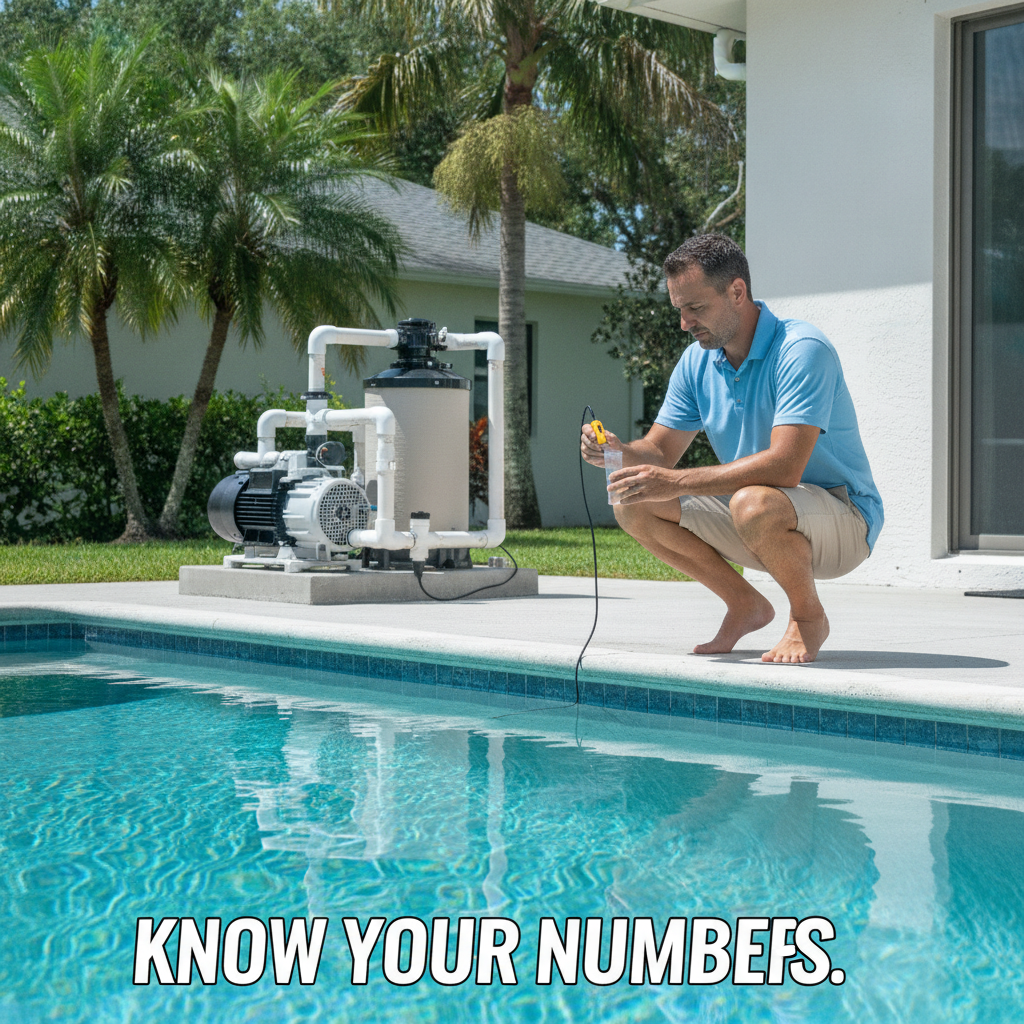
Every Route Has a Few Losers
Most owners know they have at least one or two accounts that feel wrong. The drive is long, the pool eats chemicals, the customer calls on Saturdays. But gut feeling is not the same as knowing. This post gives you a concrete checklist you can run against your own book today to identify unprofitable pool accounts before they do more damage.
1. The Drive Is Longer Than the Stop
Pull up a map. If you are driving eleven minutes to spend seventeen minutes on site, that account is not earning what it looks like on paper. At a loaded cost of, say, $1 per minute for your truck and your time, that eleven-minute drive costs $11 each way. Round trip is $22 before you touch the water. On a $110 monthly account serviced four times, you gross $27.50 per visit. Subtract $22 in drive time and you have $5.50 to cover chemicals, the time on site, and your overhead. You are not making money. You are just staying busy.
2. Chemical Demand That Never Settles Down
A healthy residential pool should have a fairly predictable chemical cost week to week. If one account consistently takes $4.80 in chlorine when your average stop takes $1.20, that difference compounds fast. Four visits a month at $3.60 extra is $14.40. Over a year that is $172 you did not price in. Multiply that across two or three heavy-demand pools and you have erased a month of profit. High bather load, heavy debris, a pool in full sun with no screen enclosure, a spa that gets used daily — all of these drive chemical cost up. Price for it, or acknowledge the account is running in the red.
3. The Filter Needs Constant Attention
A DE filter that needs to be broken down every six weeks is not the same job as one you inspect annually. An extra filter cleaning takes thirty to forty-five minutes. If you charge for it, fine. But if you are doing it under a flat-rate agreement and eating the labor, that account is quietly billing you for time you never recover. Same goes for a cartridge system where the homeowner refuses to upgrade to a larger tank. Some of these situations can be fixed with a direct conversation. Others cannot.
4. Chronic Late Payment
One late payment is not a pattern. Three in a row is. If you spend mental energy every month wondering whether a check is coming, that account has a hidden cost that does not show up in your chemical log. Late payers also tend to be harder to price increases with, because the relationship already has friction. Track your payment dates. If someone is consistently paying thirty or more days late on a net-fifteen agreement, that is a real problem.
5. Repeated Callbacks
A callback costs you a trip. If you are returning to the same pool once a month because the water is off, the salt cell is acting up, or the owner says it looked green on Tuesday, you need to figure out whether the problem is your work, the equipment, or the customer's expectations. If it is the equipment, recommend a repair and document that you did. If the customer just calls a lot, that is a service burden you are not being paid for.
6. Seasonal-Only Usage
Some accounts want full service from May through September and then want to pay almost nothing for a winter check. That is fine if the numbers work. Often they do not. You still make the drive. You still spend time on site. You still have a schedule slot tied up. Run the actual math on what you earn per visit in the off-season and decide whether the account justifies the spot on your route.
7. The Gate You Wait At
Five minutes at a locked gate, every visit, is twenty minutes a month. Over a year that is four hours of unpaid standing around. Some customers give you a code and it works every time. Others have a code that changes, a dog that has to be moved, a side gate that sticks. Small friction points stack up across a full route. They are easy to ignore on any single account and easy to underestimate across twenty of them.
8. The Owner Who Calls
There is nothing wrong with a customer who checks in occasionally. There is a real problem with one who calls every week, questions your chemical choices, sends photos of the water asking what that spot is, and wants to talk through every service visit. That relationship takes time. Time has a cost. If the account is otherwise solid and profitable, manage it. If the account is already marginal, a high-maintenance owner can push it firmly into the red.
9. The Rate That Has Not Moved in Three Years
Chlorine cost today is not what it was three years ago. Neither is fuel, labor, or insurance. If you have accounts that are still on rates you set in a different cost environment, those accounts are earning less in real terms every month you leave them alone. A $95 monthly rate from three years ago might need to be $120 to hold the same margin. Pull your oldest accounts. See which ones have not had a price adjustment. That list is where a lot of your margin loss is hiding.
What To Do With This List
Go through your route account by account. Mark any pool that hits three or more of these signs. Those are your candidates for a price adjustment, a direct conversation, or a clean drop. Not every unprofitable pool account is worth saving. Some should be repriced. Some should be let go so you have room to take on a better stop.
If you want a simple place to track service time, drive time, chemical cost, and payment history by account, getLucci is free for your first 50 pools. It is built by someone running a route, not a software company guessing at what the work looks like.