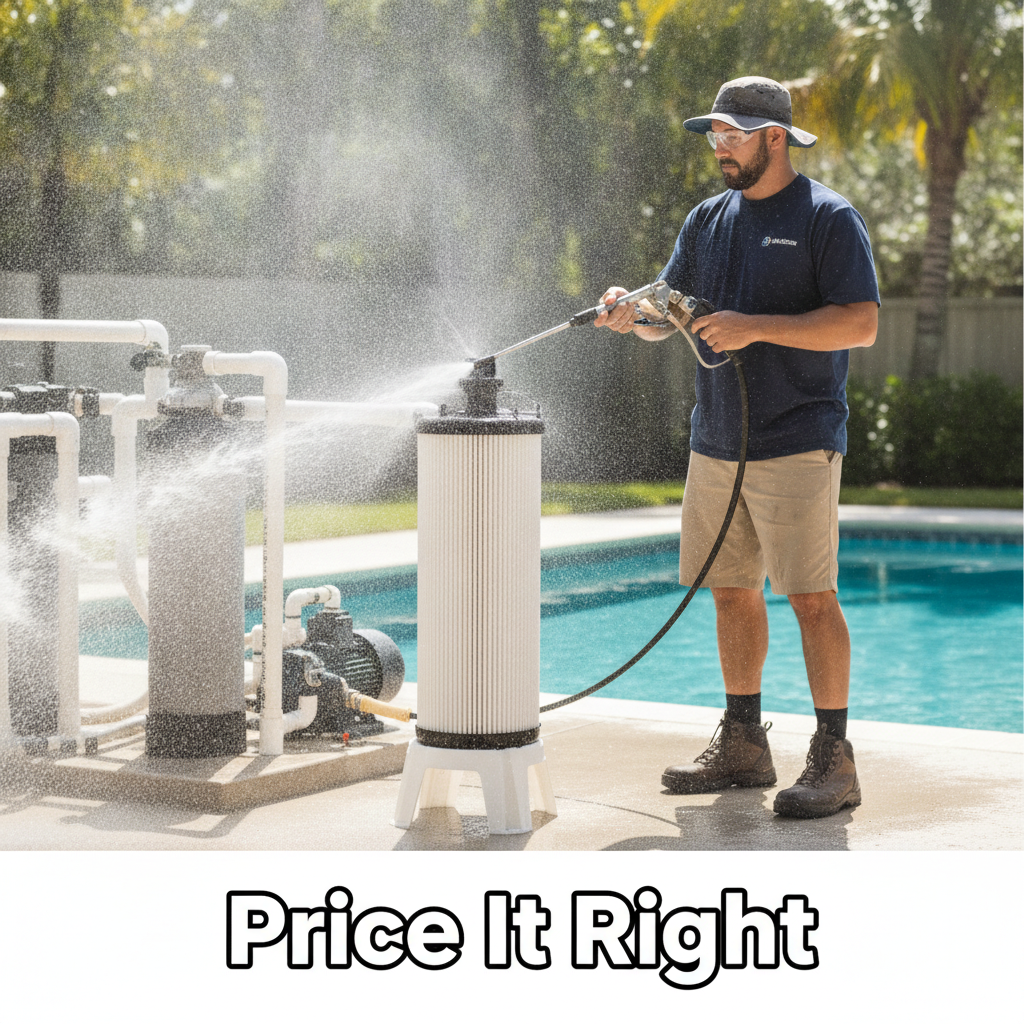
The Problem With How Most Operators Price Filter Cleans
Ask ten pool service operators what they charge for a filter clean and you will get ten different numbers, most of them too low. Not a little too low. Embarrassingly too low. Guys charging $45 for a DE tear-down that eats 45 minutes of a Tuesday morning. That is a wage cut disguised as a service call.
The reason is usually that the price was set years ago, never revisited, and customers never complained. Customers not complaining is not the same as the price being right.
Start With Your Real Cost Per Hour
Before you can set a pool filter cleaning price that makes sense, you need to know what an hour of your time actually costs your business. Not what you pay yourself. What it costs to run the truck, cover insurance, pay for fuel, account for the hours you spend quoting, billing, and driving between jobs.
A simple way to think about it: if you want to clear $75,000 a year after expenses on a one-truck operation, and you have roughly 1,600 billable hours in a year, you need to average around $47 per billable hour just to hit that number. Add your overhead and you are probably looking at a target of $65 to $85 per billable hour before you are actually building anything.
Use whatever number fits your situation. The point is to have a number, and use it.
Break Down What a Filter Clean Actually Takes
Let us work through a cartridge filter clean as a concrete example.
- Drive time: 12 minutes average to get to a standalone service call
- On-site time: 35 minutes for a two-cartridge filter, including hosing, inspection, reassembly, and a quick water check
- Drive back or to next stop: another 10 minutes absorbed into your day
- Total time attributed to this job: roughly 55 minutes
At a $70 per hour target, that is about $64 in labor cost alone.
Now add materials.
- Filter cleaner chemical: $3.50 to $6 depending on what you use and whether you pre-soak
- O-ring lube if you replace it: $1
- Disposable gloves, paper towels, rinse water from your tank: call it $1.50
So you are looking at roughly $70 in cost before you have made a single dollar. A $45 filter clean is not a service. It is a donation.
DE Filters Cost More and Should Be Priced That Way
A DE tear-down takes longer and has a real disposal problem that cartridge cleans do not. Used DE is a pain to get rid of responsibly. You are hauling it out in a bag, it goes in your truck, and eventually it has to go somewhere.
Add 15 to 20 minutes of labor over a cartridge clean. Add the cost of fresh DE to recharge the filter after cleaning. Add disposal hassle. A DE filter clean that is priced the same as a cartridge clean is priced wrong.
A reasonable starting point for a DE tear-down and recharge is $30 to $40 more than your cartridge clean price, before you factor in whether the grids need replacing.
The Quarterly Clean Arithmetic on a 100-Pool Route
This is where the underpricing really shows up. Run the numbers across a route.
Say you have 100 pools. Assume 60 percent have cartridge filters and 25 percent have DE. The remaining 15 percent have sand, which you are backwashing on service visits and charging separately for full cleans less frequently. For this example, focus on the 85 pools getting a quarterly clean.
- 85 filter cleans per quarter
- Current price: $55 each
- Quarterly revenue from filter cleans: $4,675
Now reprice at a realistic number. Cartridges at $85, DE at $120.
- 60 cartridge cleans at $85: $5,100
- 25 DE cleans at $120: $3,000
- Quarterly revenue: $8,100
That is a difference of $3,425 per quarter. On the same 100-pool route. Doing the same work. That is $13,700 a year you are leaving on the table if your prices look like the first column.
Some customers will push back on a price increase. A few might leave. If a customer leaves over a fair price for skilled labor, they were going to be a problem anyway.
How to Present the Price Without Apology
Quote filter cleans as a separate line item, never buried in a vague annual service fee. When a customer can see what they are paying for, the conversation is different. They know what a plumber charges to show up. They know what an HVAC tech charges to pull and inspect a coil. A filter clean is a skilled service with real materials and real time behind it.
Be specific when you quote. Tell them what is included: full disassembly, element cleaning, O-ring inspection, system reassembly, and a water test after startup. That is not a sales pitch. That is just describing the work so they understand the value.
If you are still quoting filter cleans verbally and trying to remember what you charged each customer last time, that is part of the problem. Inconsistency in pricing costs you money in two ways: you undercharge some customers by accident, and you have no baseline to work from when costs go up.
Track Your Time and Revisit the Price Annually
Your costs go up every year. Fuel, chemicals, insurance, labor if you have a tech. Your filter clean price should go up too, at minimum to keep pace.
If you want to know whether your filter clean time estimates are accurate, track a few jobs. Note when you pulled into the driveway and when you left. Do it for ten cleans. You will probably find you are 15 minutes over your assumption on at least a third of them.
Getting your service history, job timing, and pricing in one place makes this easier. getLucci tracks exactly this kind of job data for small routes, and it is free for your first 50 pools if you want to see whether it fits how you work.
Price your filter cleans for what they cost to do well. That is the whole argument.