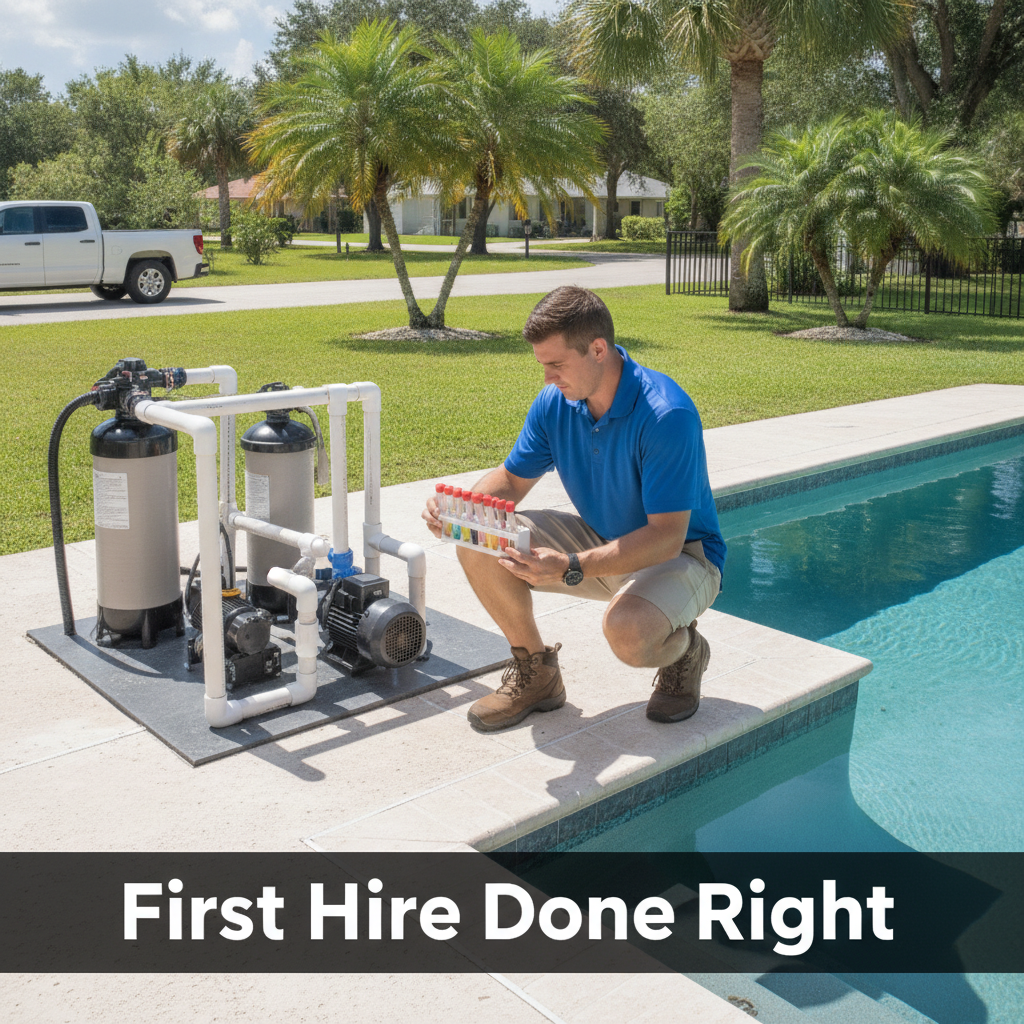
When Hiring Makes Sense and When It Doesn't
Most owner-operators wait too long. You're doing 80 pools, working six days a week, and telling yourself you'll hire when you hit 100. By then you're already losing accounts because you're rushed and callbacks are slow. The better trigger is when you're regularly skipping filter cleanings or brushing faster than you should. That's when the route is already suffering.
That said, hiring a pool technician is not the answer to a broken schedule. If your routing is a mess and your chemical costs are out of control, a new hire will just multiply the problem. Fix the operation first, then bring someone in.
Where to Find Candidates Worth Interviewing
Skip Indeed for your first pass. The applicants who find you through a sign on your truck or a post in a local Facebook neighborhood group are often better fits. They already live nearby, they've seen your truck, and they reached out on their own initiative.
Other places that actually work:
- Local pool supply stores. Counter staff know every tech in the area and hear who's unhappy or looking.
- Community colleges with landscaping or facilities programs. Students in their second year often want hands-on trade work.
- Your own customers. A retired tradesman or a younger person mentioned in passing that they're looking for outdoor work. You already have a relationship.
- Other service industries with the same skill overlap — irrigation techs, HVAC helpers, pest control drivers. They already understand service routes and equipment pads.
Avoid hiring anyone currently running their own book of residential accounts. The legal exposure is real and the relationship gets complicated fast.
What to Pay
This varies by market, but here's a worked example you can adjust. Say you're in a mid-size Florida metro. A new tech with no pool experience but a clean record, good driving history, and a mechanical aptitude is worth around $18 to $20 an hour to start. Someone who's done a season or two and can backwash a DE filter and swap a salt cell without a call to you is worth $21 to $24. Above that, you're competing with pool builders and larger companies, and the candidate probably wants their own route eventually anyway.
Don't lowball it trying to protect margin. A $16-an-hour tech who quits in six weeks costs you more in retraining and account damage than the $2 difference ever saved you.
What to Check Before You Make an Offer
Run a motor vehicle report. Non-negotiable. One DUI or a suspended license and your insurance carrier will have a problem. Call your agent before you hire anyone and confirm what your policy requires.
Do a background check. Use a service, not just a Google search. Keep a copy on file.
Check references by actually calling them. Ask one specific question: would you hire this person again? The pause before the answer tells you a lot.
If they have any pool experience, ask them to walk you through how they handle a green pool or a salt cell that's reading low output. You're not quizzing them — you're listening for whether they think the problem through or just guess and move on.
The Paid Ride-Along That Tells You More Than Any Interview
Before you make a hire, pay the candidate for a full day on the truck with you. Call it a working interview, pay at least $120 for the day in cash, and treat it like a real workday. Do your normal stops.
Watch three things specifically. First, how they handle the physical repetition by stop eight or nine, when the novelty is gone. Second, whether they ask questions or just wait for instructions. Third, how they treat the customer's property — gates, equipment covers, whether they leave the yard the way they found it.
You will learn more in that one day than in three formal interviews. If they're checking their phone constantly, showing up slow to the truck, or getting sloppy at the last few stops, that's your answer. Thank them for their time and move on.
The ride-along also protects you. Someone who seemed great on paper and terrible in person hasn't been promised anything yet.
What the First Hire Really Costs
Here's where most people underestimate badly. You're not just paying a wage.
Take a realistic week. Your tech runs 30 stops at an average of $110 per pool per month, billed weekly that's roughly $825 in revenue they're responsible for. Sounds good. Now count the costs against that week.
- Wages at $20 per hour, 40 hours: $800
- Payroll taxes and workers comp, roughly 18 to 22 percent on top: around $160
- Chemical cost per stop, say a $4.80 average for a residential pool: $144 for 30 stops
- Truck operating cost — fuel, wear, insurance on a second vehicle or mileage if they use yours: $180 to $250 depending on your area and routes
- Your own supervision time — answering calls, checking their work, handling callbacks — easily 5 to 7 hours a week at whatever your time is worth: real cost even if you don't write a check for it
That's $1,284 to $1,354 in hard costs against $825 in weekly revenue from their stops. You're in the red until they're running more pools or you've freed yourself up enough to sell and service additional accounts. The break-even on a first hire is typically 90 to 120 days if everything goes reasonably well. Plan for that, not for immediate margin improvement.
Building the Route So They Can Actually Run It
The biggest failure mode with a first hire is that the route only exists in your head. Addresses on a napkin, no stop notes, no record of which pools take what chemical or have a gate code. You either stay in the field supervising forever, or they make expensive mistakes.
Before your new tech's first solo week, every stop needs a written record: gate access, equipment notes, any customer quirks, what the pool typically needs. If you're already using software to manage your route, this is easy. If you're not, build it in a spreadsheet at minimum.
If you want a simple way to get that structure in place before your first hire shows up, getLucci is free for your first 50 pools — it's built by someone running a route, so it covers the stop notes, scheduling, and basic records a new tech actually needs without a lot of setup overhead.