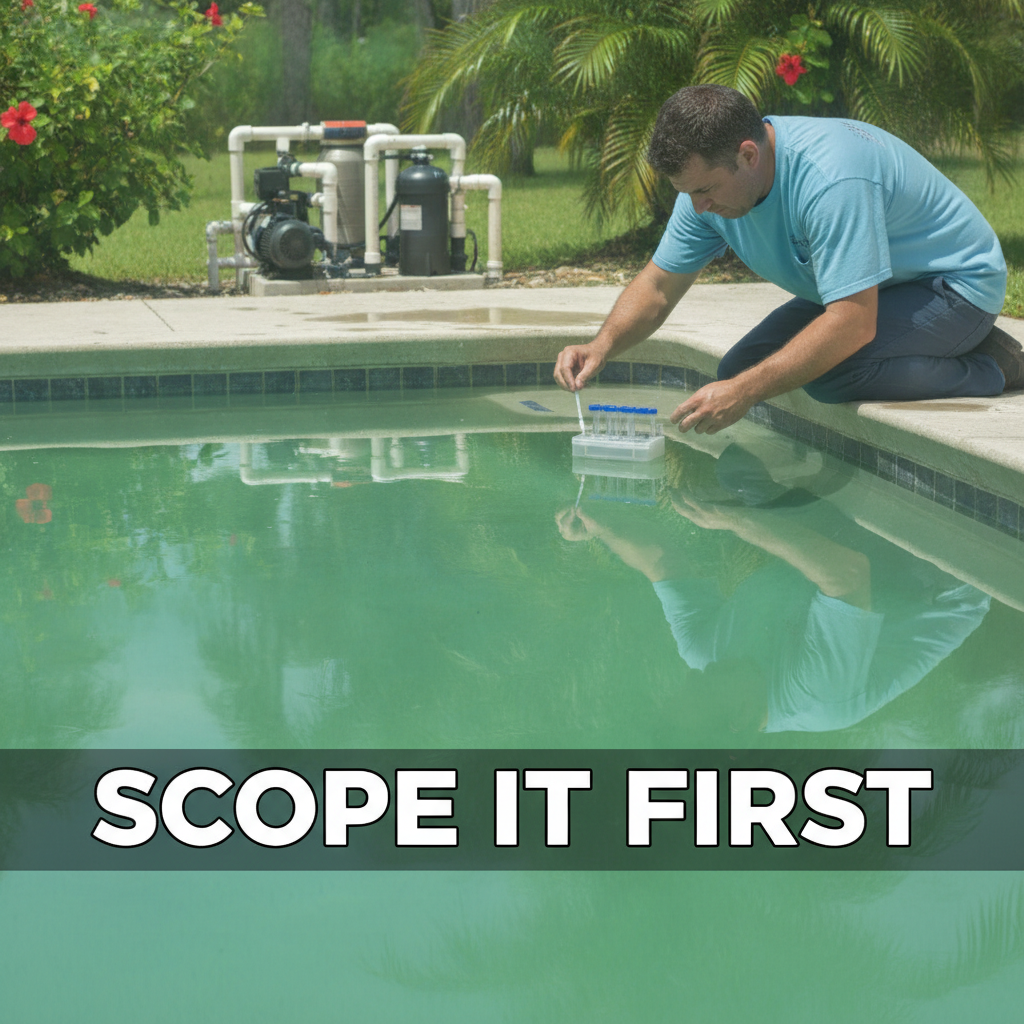
A Green-to-Clean Is Not a Service Call
The customer calls, says the pool has been green for a few weeks, wants it fixed. You show up, quote a number, and start treatment. Two visits and three chemical loads later you are into the job deeper than the quote covered. Sound familiar?
That is what happens when you treat a green pool recovery like a regular service visit with a markup. It is not. It is a multi-day project with variable costs, and green pool cleanup pricing has to reflect that.
Scope It Before You Quote It
Never give a flat price over the phone. Never. A pool that has been green for two weeks is a completely different job from one that has been abandoned for four months. You need to see it before you put a number on it.
When you get on site, look at these things in this order.
- Water visibility. Can you see the first step? The main drain? No visibility at all? Each level adds time, chemical cost, and uncertainty.
- Filter condition. A clogged DE filter that needs a full teardown is a separate line item, not something to absorb into your chemical charge.
- Phosphate load. High phosphates mean your chlorine is fighting two battles. If you do not test for them and account for them, your chemical budget is wrong before you start.
- Equipment function. Is the pump running? Is the salt cell scaled or dead? A green pool with a broken pump is not your job to fix at a green-pool rate.
- Debris load. A pool full of leaves and sludge needs vacuuming to waste before treatment even starts. That is labor. Charge for it.
Build the Quote in Layers
Think of it in three parts: chemicals, labor, and return visits.
Chemicals are the easiest to get wrong. A black or dark green pool with zero visibility might need 10 to 15 pounds of calcium hypochlorite just to get started, plus a phosphate remover, clarifier, and possibly a flocculant if you are vacuuming to waste. Price your chemicals at a real margin, not cost-plus-ten. You are sourcing, transporting, and applying them. That is worth something.
Labor is where people undercharge. A proper green-to-clean involves at minimum two site visits and often three or four. Each visit takes time: travel, testing, adjusting, brushing, backwashing, cleaning up. If your loaded hourly rate for truck and tech time is $95, and each visit runs 45 minutes including drive, that is around $71 per visit. Three visits is $213 in labor before you buy a single pound of chlorine.
Return visits need to be in the contract upfront. Tell the customer how many visits are included, what the process looks like, and what happens if the pool does not respond on schedule. Some pools clear in four days. Some take twelve. You need language that protects you if it runs long.
A Worked Example
Here is a real-ish job. Residential pool, about 15,000 gallons, green with maybe two feet of visibility, phosphates around 800 ppb, filter needs backwashing but is otherwise functional. No equipment issues.
Chemical costs: 12 lbs of cal-hypo at $2.10 per pound is $25.20. One quart of phosphate remover, $14. Clarifier, $6. Call it $50 in chemicals at cost. You sell those at a 60 percent margin: $80.
Labor: four visits at 45 minutes each including an average 12-minute drive. That is three hours of truck-and-tech time. At a $95 loaded rate: $285.
Total quote: $365. Round to $375 and you have a small buffer for an extra bag of shock if the pool fights you.
If you had quoted $199 on the phone because that sounded like a fair green pool cleanup price, you just lost around $175 and a half-day of productive route time.
What Can Go Wrong
Plenty. Here is what catches people out.
- The pool does not clear. Sometimes you do everything right and the water stays hazy or turns back green because of a circulation problem you did not find on the first visit. Agreeing upfront on what is included prevents an ugly conversation later.
- Hidden equipment damage. You start treatment, the pump dies on day two. Now you are waiting on a repair before the chlorine can circulate. Your timeline slips. The customer gets impatient. Have a plan for this in writing.
- The customer adds scope. They saw a YouTube video and want you to drain it halfway instead. That is a different job. Price it as one.
- You underestimated the debris. Vacuuming sludge to waste on a badly neglected pool can take 90 minutes. If you did not see that on the scope visit, it will eat your margin.
When to Walk Away
Some jobs are not worth taking. Black algae on a plaster pool with failing equipment and a customer who has already complained about your quote before you have started: walk away. A pool that has been stagnant so long it has become a mosquito habitat with structural issues at the waterline: walk away.
The test is simple. Can you do this job, do it well, and make money on it? If any part of that answer is no, passing is a legitimate business decision. Losing money on a rescue job and then having the customer unhappy anyway is the worst outcome. It happens more than people admit.
Track It So You Learn From It
After the job is done, look at what you actually spent versus what you quoted. How many visits did it really take? How much chemical? Where did the estimate drift?
If you are using route management software to track jobs and costs per stop, that data builds up fast. getLucci lets you log expenses and time per job so you can see your actual margin on work like this, not just guess. It is free for your first 50 pools if you want to try it without committing to anything.
Most operators who do this kind of post-job review find they are undercharging on green pools by 20 to 40 percent. The scope visit fixes most of that. The rest is just doing the math honestly before you commit to a number.