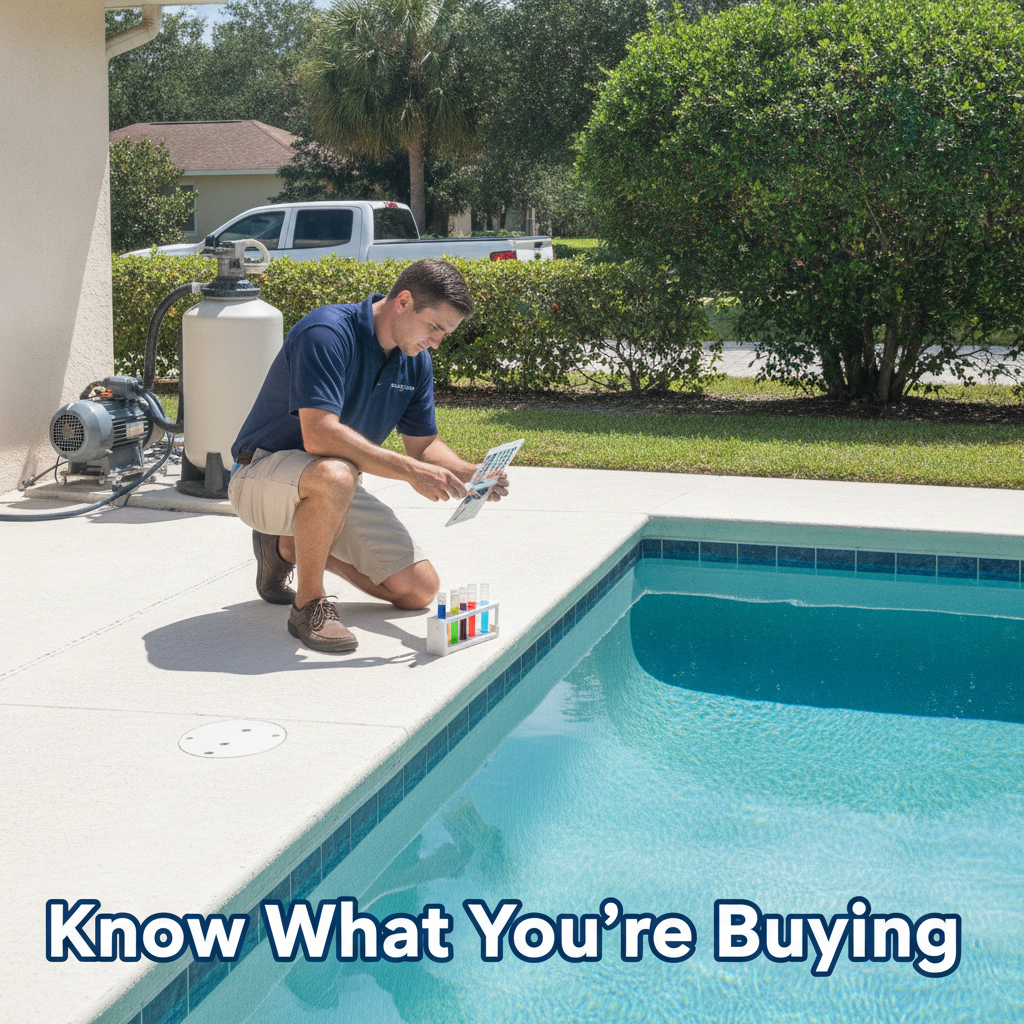
The Number That Tells You Almost Nothing
Every pool route listing starts the same way. "Established route, $8,400 gross monthly billing, great area, motivated seller." That number is the beginning of the conversation, not the end of it. If you make an offer based on gross billing alone, you are guessing. Here is what to actually dig into before you sign anything.
Ask for a Density Map First
Print the customer list on a map before you look at anything else. Drive time kills profitability faster than a bad chemical bill. A route with 60 pools sounds different when you realize 14 of them are 40 minutes from the other 46. That cluster across town costs you roughly an extra hour of windshield time every week. At a realistic labor cost, that is $200 a month in time you are not getting paid for, and that is before you factor in fuel.
A tight route is worth more than a loose one at the same billing number. If the seller cannot produce a map, ask for addresses and make one yourself. It takes 20 minutes in Google Maps and it will show you things no broker pitch ever will.
Per-Account Rates and How Long Since Each Moved
Gross billing hides rate variation. You want a line-item list: every account, what they pay monthly, what service they get, and when they became a customer. An account paying $110 a month that has been there for six years is a very different asset from an account paying $185 that signed up four months ago and has already called twice to complain.
Low rates on old accounts are a real problem. Sellers often avoid raising prices on loyal customers for years. You buy the route, you inherit the awkward conversation. Some of those accounts will leave the moment you try to correct a rate that should have gone up three years ago. Price the risk of losing five or six underpriced accounts into your offer.
Ask specifically: what percentage of accounts are below $120 a month? What is the average rate per account? If the seller does not have this broken out, that is a red flag about how the business has been managed.
Chemical Spend Per Account
A pool at $110 a month looks fine until you find out the seller has been running it on trichlor tabs, the CYA is at 140, and the salt cell is borderline dead. You are going to walk in and spend money fixing problems that the customer will not understand and will not want to pay for.
Ask for the actual chemical spend per account per month. Not a ballpark. The invoices or the supplier statements. A well-run residential account should cost somewhere in the range of $4 to $8 in chemicals depending on size, bather load, and whether it is salt or not. If the seller is spending $18 on a pool billing $95, that account is losing money. If they cannot tell you their chemical spend at all, they are not running a real business, they are running a truck.
Churn Over 24 Months
This is the question most buyers forget to ask. How many accounts did this route have 24 months ago, and where did the ones that left go? Natural churn happens. People move, sell houses, get divorced, decide to do it themselves. That is normal. But if a route has turned over 30 percent of its accounts in two years and is still at the same billing number, that means the seller has been replacing lost accounts the whole time. The moment he stops, the billing starts dropping.
Ask for the account history going back two years. If the seller runs paper or a spreadsheet, this might take some digging. If he cannot produce it, that tells you something. A stable route should have annual churn somewhere in the range of 8 to 15 percent. Higher than that, start asking why customers left.
Who Do the Customers Think Their Pool Guy Is
This one matters more than most buyers realize. In this business, customers are often loyal to the person, not the company. If the seller has been servicing these accounts for 12 years and his name is Mike, some of those customers will follow Mike when he leaves, not stay with whoever bought his list.
Ask the seller how he operates. Does he use a company name and uniform, or does he work as "Mike the pool guy"? Does he have a business phone number or do customers text his personal cell? Are there any accounts where his family or close friends are the customer? Those are flight risks the moment the face changes.
The cleanest transition happens when the seller has operated as a branded business with a separate phone number, company name on the truck, and some kind of system the customer has experienced, like online billing or automated service reports. That creates some distance between the seller's personality and the customer relationship.
What a Worked Example Actually Looks Like
Say you are looking at a route billing $7,200 a month across 64 accounts. Average rate is $112. The density map shows 52 accounts within a tight 8-mile area, and 12 accounts scattered across two zip codes 25 minutes away. Chemical spend averages $9.40 per account. Churn over 24 months was 22 percent. The seller works under his own name and customers text him directly.
That is not an $8,200-a-month route with a standard multiple. That is a route with a chemical problem, a geographic drag, high churn, and a retention risk built around one person's relationships. You should price all of that in, or walk.
How to Organize What You Find
Once you have the data, you need somewhere to put it. Running the numbers in a spreadsheet works, but if you are already managing a route and adding to it, you need to see how the new accounts fit into your existing schedule. getLucci is free for your first 50 pools and was built by someone running a 100-pool route, so the structure reflects how this work actually gets done rather than how a developer imagined it does.
When buying a pool route, what to look for is not a mystery. It is just data that most sellers have not organized because they never needed to. Make them organize it. The ones who cannot are usually the ones selling you a problem, not a business.